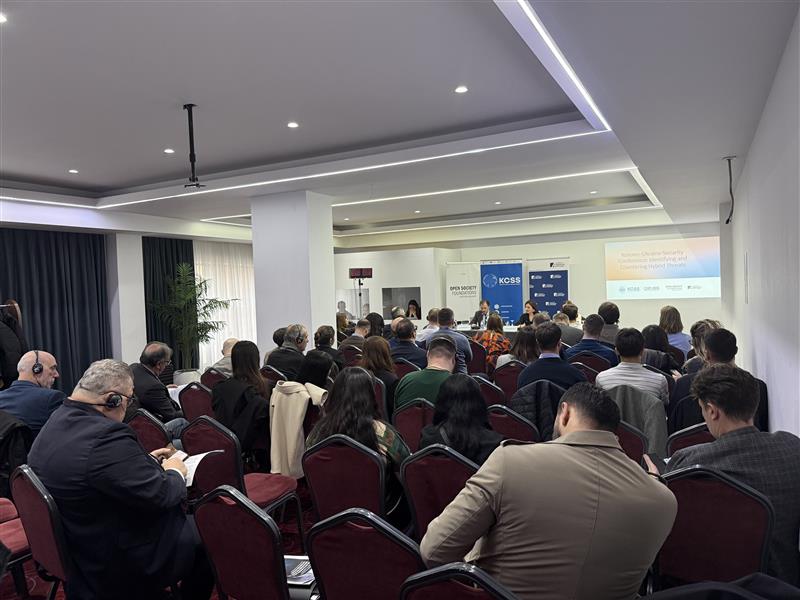
Kosovo–Ukraine Security Conference: Identifying and Countering Hybrid Threats

18/12/2025

Konferenca e Sigurisë Kosovë-Ukrainë: Identifikimi dhe Kundërshtimi i Kërcënimeve Hibride


The Kosovo–Ukraine Security Conference recently brought together policymakers, security experts, researchers, and civil society representatives to address shared security challenges and exchange lessons learned in countering hybrid warfare across Europe. The event opened with remarks underscoring that regional cooperation and institutional resilience are central pillars of contemporary security and defense.

The program featured three strategic panel discussions:

  • Panel I: Hybrid Threats and Warfare – focused on conceptual frameworks and practical experiences related to hybrid influence, outlining the tools, narratives, and methods used by external actors to destabilize societies. The panel emphasized the role of resilient institutions, informed public discourse, and civil society in countering hybrid threats.
  • Panel II: The "Russian World" (Russkiy Mir) Concept – examined how media, culture, and religion are instrumentalized as tools of hybrid warfare. Drawing on experiences from Ukraine and the Western Balkans, speakers provided concrete examples of disinformation campaigns, identity-based narratives, and influence operations, with particular attention to their impact in Kosovo.
  • Panel III: Plausible Deniability & Covert Operations – explored the use of covert tactics and non-state actors, including paramilitary formations, as instruments of hybrid warfare. The discussion included case studies such as the Banjska attack, alongside broader considerations of cybersecurity threats and hybrid tactics in the Western Balkans.

A central highlight of the conference was the presentation of two in-depth analytical reports, including a joint study by KCSS and CENSS. Supported by OSF Western Balkans and Konrad-Adenauer-Stiftung (KAS), the reports identify clear parallels between Russia’s hybrid tactics in Ukraine and those employed in Kosovo and the Western Balkans.

Access the Full Reports:

Eng: https://qkss.org/en/publikimet/kercenimet-hibride-ne-nje-peizazh-gjeopolitik-ne-ndryshim-lufta-ne-ukraine-dhe-implikimet-e-saj-per-kosoven-dhe-ballkanin-perendimor 

Alb: https://qkss.org/al/publikimet/kercenimet-hibride-ne-nje-peizazh-gjeopolitik-ne-ndryshim-lufta-ne-ukraine-dhe-implikimet-e-saj-per-kosoven-dhe-ballkanin-perendimor 

Eng: https://qkss.org/images/uploads/files/Russia%E2%80%99s_Expanding.pdf 

Alb: https://qkss.org/al/publikimet/arsenali-ne-rritje-i-veprimeve-te-rusise-lidhje-kosove-ukraine/ 

The conference concluded by offering actionable recommendations to mitigate the impact of external destabilization and strengthen European collective security through enhanced cooperation between Kosovo, the Western Balkans, and Ukraine.

This activity is part of a broader project jointly implemented by the Kosovar Centre for Security Studies (KCSS) and the Center for Security Studies CENSS (Ukraine), with the support of Open Society Foundations Western Balkans and the Konrad-Adenauer-Stiftung Kosovo