28/04/2026
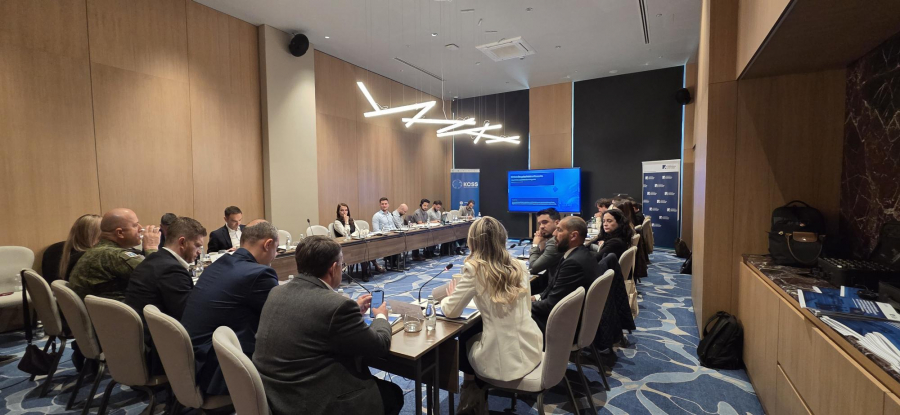
The Kosovar Centre for Security Studies (KCSS), with the support of the Konrad Adenauer Stiftung (KAS) Office in Prishtina, launched three new reports titled, Kosovo Foreign and Security Challenges and Priorities; Assessing Opportunities for Collaboration between the Western Balkans and European Defence Mechanisms, including the EDA, with emphasis on Kosovo; and Kosovo in 2030: A Foresight Discussion Paper on Foreign and Security Policy of Kosovo, at a policy conference in Prishtina. The event brought together policymakers and experts across two panels to discuss Kosovo’s current foreign and security policy landscape and its long-term strategic outlook, with contributions from discussants including Col. Ahmet Ajeti (Ministry of Defense), Rozafa Ukimeraj Çuni (Senior Research Fellow at KCSS), Senad Sabovic (EIP) and Lulzim Peci (KIPRED).
Discussions focused on Kosovo’s positioning within a shifting European and global security architecture, emphasizing that the country’s future will depend less on single breakthroughs and more on how key strategic drivers evolve over time. A central theme was the growing need for strategic foresight and scenario planning, particularly as global uncertainties, from shifting U.S. engagement to a more geopolitical European Union, reshape the environment in which Kosovo operates.
Participants highlighted that Kosovo remains secure but still dependent, aligned with Western partners yet not fully integrated, and facing persistent structural challenges. Despite this context, there have been some momentums where Kosovo is gradually moving from a security consumer toward a more active security provider, though this transition requires stronger institutional capacity and sustained internal stability. At the same time, there are expectations for a more proactive EU engagement in the region, while the importance of NATO and continued U.S. involvement remains central, alongside greater burden-sharing in security responsibilities. In this context, participants also noted the presence of external influences, including Russia and China, whose activities are often viewed as challenging the stability and strategic orientation of the region.
The discussion also underlined that Kosovo’s trajectory will be shaped by several interconnected factors, including progress in EU integration, the dynamics of the Kosovo–Serbia dialogue, and the evolution of NATO’s role. Particular emphasis was placed on the risk of long-term stagnation, rather than sudden crisis, if reforms slow down and external momentum weakens.
In conclusion, participants stressed the importance of energy security, the need for well-designed and proactive policies for the northern part of Kosovo, and the role of internal governance and institutional capacity as decisive variables in shaping future scenarios. As highlighted throughout the event, Kosovo must move beyond reactive approaches and invest in preparing for multiple plausible futures, ensuring resilience in an increasingly uncertain geopolitical landscape.
The reports can be found on the links below: