6/05/2025
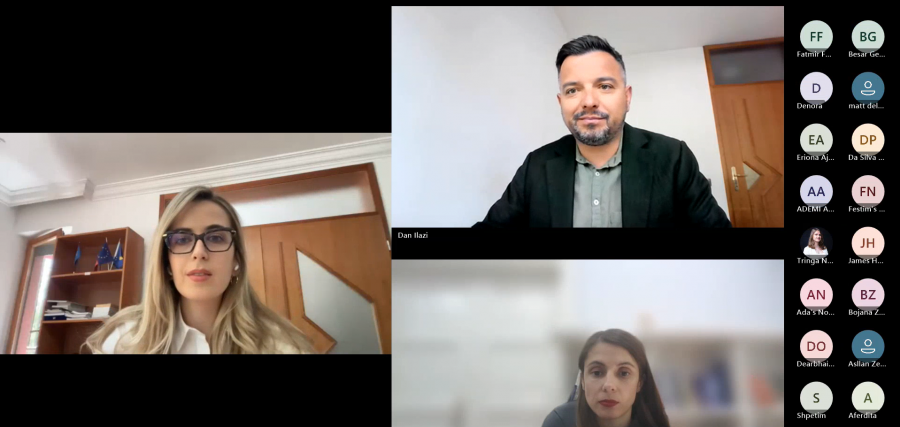
The Kosovar Centre for Security Studies (KCSS) hosted a webinar focused on their latest report, “The Kosovo-Serbia Dialogue Between Achievements, Setbacks, and Unknowns,” as part of an initiative backed by the National Endowment for Democracy (NED). The publication provides a comprehensive overview of the dialogue process between Kosovo and Serbia for the past four years. The aim of the discussion was to further expand on the authors’ findings by engaging in discussions, assessing the progress, challenges, and outlook of the Kosovo-Serbia discourse from both sides’ perspectives.
Report authors Jeta Loshaj, Ramadan Ilazi, Katarina Tadić, and Shpetim Gashi led the discussion, which looked into Kosovo’s approach, under Prime Minister Albin Kurti, including attempts to establish sovereignty in the north and the debated ongoing ASM issue, as well as Serbia’s role in the discourse and broader geopolitical factors, such as the Russia-Ukraine conflict. The role of the EU and US as facilitators is further assessed, with particular emphasis on the impact of shifting international priorities and the new EU leadership.
Some of the key takeaways of the discussion include the following: The Kosovo-Serbia dialogue aims to normalise relations between the two; however, it has faced a plethora of challenges and setbacks, namely in the last four years. Ms. Tadić stated that some of these setbacks include the hesitation in implementing the Ohrid agreement and the ongoing mutual distrust. It was also mentioned that Kosovo has appeared to be “betrayed by internationals” over the lack of recognition from five EU member states following the agreement, which Kosovo was allegedly ready to sign. Furthermore, under Kurti, Kosovo has embodied a tougher stance, particularly in the north, asserting control and dismantling Serbian parallel structures. Kosovo is currently refusing to grant meaningful powers to the ASM, labelling it as a threat to sovereignty.
Additionally, discussions highlighted that while the EU remains the key facilitator, it has demonstrated inconsistent commitment and diminishing leverage; notable reasons being the significance of Serbia’s lithium reserves and the country’s democratic regression. Ms. Tadić emphasised the contradiction of the EU backing a government in Serbia that is overtly anti-EU and anti-Western, whilst alienating its pro-European civil society. Parallely, the US has supported Kosovo’s independence, but without consistently pressuring Serbia for recognition. When asked, Mr. Gashi acknowledged the fears that Trump’s return could further reduce Western engagement, though he downplayed the likelihood, suggesting Trump to be preoccupied with other ambitions. Security and violent incidents, such as the Banjska attack in 2023, and the closure of Serbian-backed parallel institutions in Kosovo, have escalated fears of instability, while NATO-led KFOR remains a crucial security blanket despite possible reductions in US troop presence.
Finally, the ongoing geopolitical turmoil, including the war in Ukraine and shifting EU-US priorities, leaves the dialogue’s future uncertain. Mr. Ilazi notes that key unresolved questions are the following, whether new EU instruments will be introduced, such as: First, if they (EU) have sufficient political capital to complete the dialogue, urging for stronger EU cohesion and a clearer vision for the end state. Second, how Kosovo can navigate its path to EU and NATO integration without Serbia’s formal recognition and stressing that without significant international pressure and democratic reforms in Serbia, a comprehensive agreement remains unlikely.
This webinar, supported by the National Endowment for Democracy (NED), was an opportunity for the authors to expand on their report “The Kosovo-Serbia Dialogue Between Achievements, Setbacks, and Unknowns,” as well as have a discussion with the audience. It offered further insight into the strategic challenges facing the dialogue. The activity is part of a wider project titled “Increasing Government Transparency and Accountability in Interethnic Dialogue,” supported by National Endowment for Democracy (NED).