25/04/2025
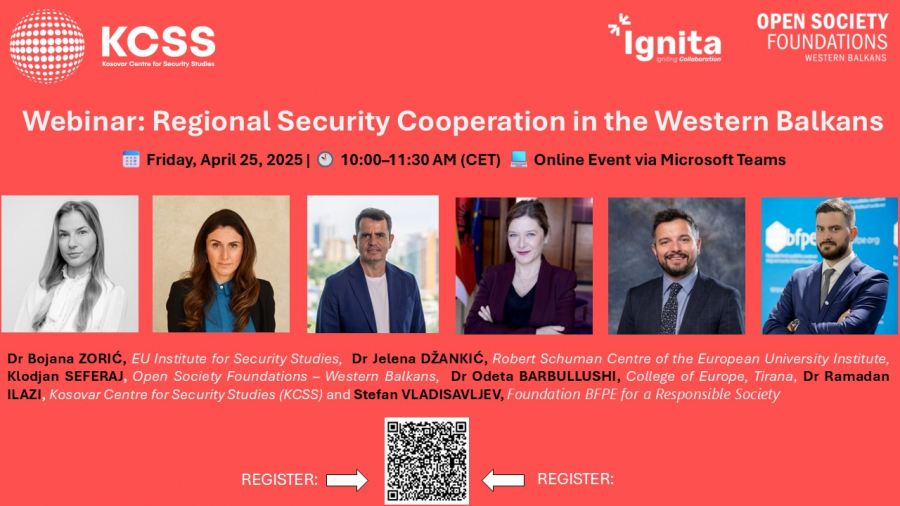
Webinar on Regional Security Cooperation in the Western Balkans: Why the Western Balkans Can’t Wait on Cooperation?
April 25, 2025, Prishtina: Security in the Western Balkans is no longer a peripheral matter—it is a central test of EU’s ability to build a resilient and integrated security architecture in the face of mounting uncertainty. For this reason, the Kosovar Centre for Security Studies (KCSS), within the framework of the #IGNITA Initiative and with the support of the Open Society Foundations – Western Balkans, held an online conference today to explore the challenges and opportunities for strengthening regional security cooperation in the Western Balkans and enhancing ties with the European Union.
The event was organized under the ASCEND-WB6 project, a KCSS-led initiative supported by OSF-WB, that promotes the gradual integration of the Western Balkans into the EU’s security and rule of law architecture. The conference brought together leading experts and analysts to assess the strategic imperatives for deeper cooperation in the face of growing regional and global security threats.
In the framework of today’s webinar, KCSS also launched a new expert report titled “Regional Security Cooperation in the Western Balkans”. The report argues that regional security cooperation is not only essential for managing transnational threats, but also crucial for reinforcing democratic resilience, institutional capacity, and the EU accession path for the WB6 countries.
The discussion featured presentations by four leading regional analysts:
In his opening remarks, Dr. Ramadan Ilazi, Head of Research at KCSS, underscored the moment’s urgency: “As the Western Balkans navigate a volatile geopolitical environment—marked by Russian aggression, hybrid threats, and shifting transatlantic alliances—regional security cooperation has evolved from a technical necessity into a strategic imperative. Long seen as a fragmented periphery, the region now sits on the frontline of Europe’s broader security architecture. Despite institutional hurdles, political friction, and uneven reform progress, enhanced cooperation among the Western Balkans is not merely desirable—it is essential for democratic resilience, crisis preparedness, and alignment with EU security frameworks. This report identifies four interconnected arguments demonstrating why regional security cooperation is indispensable for the region’s stability and future.”
Klodjan Seferaj from the Open Society Foundations – Western Balkans emphasized the role of the #IGNITA Initiative in promoting shared security and civil society engagement across the region.
In her remarks, Dr. Bojana Zorić reminded that: “The Western Balkans should no longer be seen as a separate security concern, but as an integral part of Europe’s broader security architecture. Their engagement with EU/international security agencies – through intelligence sharing, data exchange, and joint operations – is not a concession, but an operational imperative.”
Speaking on the link between security and democratic resilience, Dr. Jelena Džankić said: “While the current European, and even the global focus, is on reinforcing the military capabilities of states, strengthening the core democratic resilience is as important. The reason for this is that individuals are both the providers and recipients of security.”
Addressing regional trust-building and the role of structured frameworks, Dr. Odeta Barbullushi noted: “Trust, or lack thereof, remains an important impediment of regional cooperation in the security front. The more the Western Balkans are embedded into European or EU-led security mechanisms, the more trust there is. (...) Furthermore, she said that “We need the Western Balkans to be more proactive on setting the agenda of security regional cooperation, and we need to establish policy continuity between different regional and European cooperation platforms, such as Berlin Process, European Political Community and EU-Western Balkans summits.”
Finally, Stefan Vladisavljev stressed the importance of civil society in countering malign foreign influence: “For governments in the Western Balkans, the message should be clear: civil society is not a threat, but a strategic partner. Integrating CSOs into national strategies to combat foreign interference is not a concession to donors and foreign presence, it is an investment in democratic sovereignty.”