12/11/2025
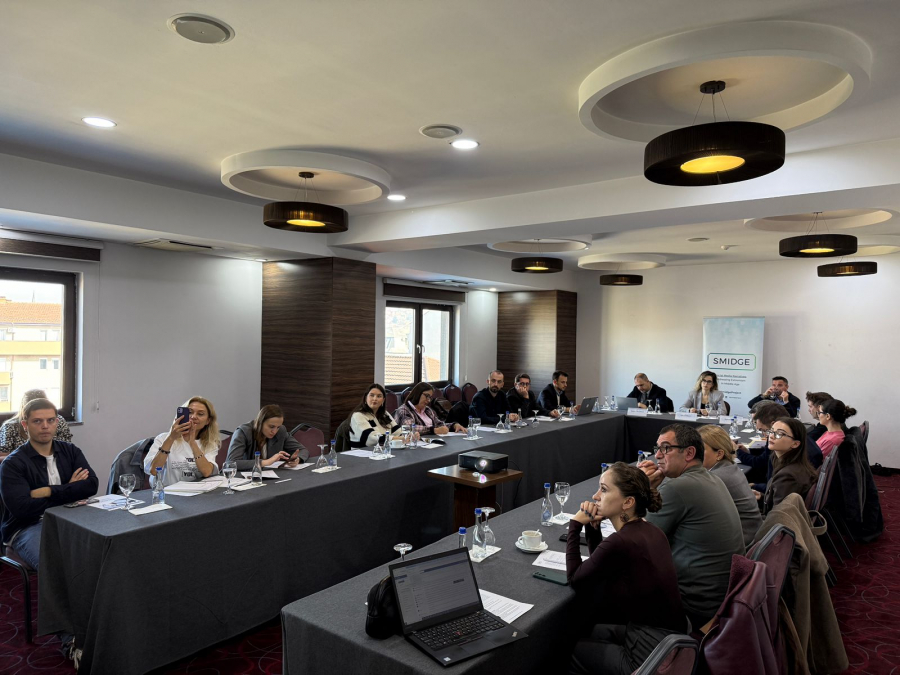
Prishtina, November 12, 2025: The Kosovar Centre for Security Studies (KCSS) today brought together security experts, researchers, and institutional representatives to discuss how disinformation and extremist narratives are shaping social trust and inter-ethnic relations in Kosovo, as well as to introduce the results and work of the SMIDGE project.
The roundtable, held under the EU-funded SMIDGE project (Social Media Narratives: Addressing Extremism in Middle-Aged Groups), explored how disinformation and conspiracy theories increasingly target citizens aged 45–65 — a demographic often overlooked in prevention policies but deeply influential in shaping public opinion and amplifying online content with real-world consequences
“Our findings show that extremist and conspiratorial content doesn’t always come from organised groups — it spreads horizontally, through everyday users who share emotionally charged material,” said Dr. Ramadan Ilazi, Head of Research at KCSS and Team Leader of the SMIDGE project. “This challenges traditional counter-extremism models. If we want to build societal resilience, we must understand how fear, uncertainty, and identity politics travel through ordinary conversations online.”
The event also underscored the project’s pioneering focus on middle-aged citizens — a population that, while highly active online, has had limited exposure to media literacy education. SMIDGE research found that this group often blends traditional and digital information sources, making them more vulnerable to hybrid misinformation targeting sensitive topics such as security, religion, migration, and public health.
Mentor Vrajolli, Executive Director of KCSS, said the project is a step forward in linking academic research with national security practice. “KCSS’s work under SMIDGE is not just about mapping online risks — it’s about understanding how disinformation shapes social cohesion, trust in institutions, and even policy debates,” he said.
Jeta Loshaj, researcher at KCSS and moderator of the discussion, emphasized the importance of inter-institutional collaboration. “Local governments and civil society can act as early-warning nodes,” she noted. “Timely, bilingual communication and trusted messengers are essential in countering falsehoods that exploit community sensitivities.”
The roundtable concluded with some practical recommendations to strengthen Kosovo’s information resilience, including better coordination between municipalities, civil society, and security institutions, and to create new opportunities for education and engagement for the middle aged individuals, especially on new media and social media platforms.
For more on the SMIDGE project, visit www.smidgeproject.eu or www.qkss.org.