10/11/2025
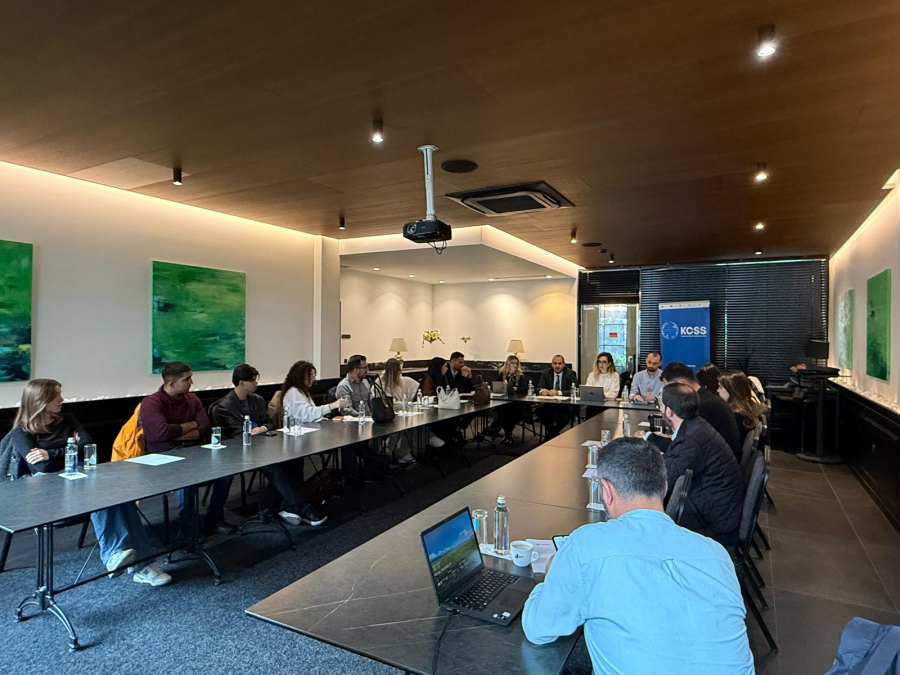
On November 11, the Kosovar Centre for Security Studies (KCSS) organized a roundtable in the Municipality of Ferizaj on “The Role of Municipalities in Promoting Rule of Law and EU Values in Kosovo.” The discussion gathered senior municipal officials, civil society representatives, and youth activists to exchange views on how local institutions contribute to advancing European values and principles of good governance. The event was moderated by Ms. Jeta Loshaj, researcher at KCSS.
Opening remarks were delivered by Mr. Albion Sherifi, Chief of Cabinet of the Mayor of Ferizaj, and Mr. Granit Sadiku, activist from the NGO Rin’ON. The event also featured a presentation by Ms. Rozafa Ukimeraj, research partner with KCSS, who shared the preliminary findings of the forthcoming report “Strengthening the Role of Municipalities in the Promotion of EU Rule of Law Values in Kosovo.”
This activity is part of the KCSS project “Strengthening the Role of Municipalities in Promoting EU Rule of Law Values in Kosovo,” supported by the Irish Department of Foreign Affairs. The project aims to deepen the understanding of how municipalities contribute to democratic governance, enhance the rule of law, and advance Kosovo’s European integration process.
Municipal Progress and Persistent Challenges
Presenting findings from KCSS’s ongoing research, Ms. Ukimeraj noted that municipalities have shown continuous progress in ensuring legality, transparency, and accountability since the signing of the Stabilisation and Association Agreement in 2015. While local governments are not directly included in national EU monitoring frameworks, they have maintained a consistent commitment to European values in governance.
According to the 2024 mid-year monitoring report, municipalities recorded average implementation rates of 52% for political criteria, 36% for economic criteria, and 69% for EU-related standards. The legality of municipal acts has also improved remarkably: from a 30% violation rate in 2016 to just 1% in 2024. Except for Prishtina and Strpce, all other municipalities reported no legal violations in their acts.
Despite these encouraging results, participants pointed out several challenges. Municipalities continue to face limited human and financial capacities, political interference, and inconsistent legal reviews. Many rely on donor-supported training rather than government-led capacity-building programs, and coordination with central institutions remains weak. The 2024–2025 EU Report on Kosovo similarly highlights the lack of effective communication between municipal and central levels.
Youth Participation and Community Engagement
In his remarks, Mr. Granit Sadiku emphasized the importance of civic participation and cooperation between municipalities and local organizations. He cited examples from Ferizaj and Hani i Elezit, where youth and village councils promote inclusive decision-making. According to him, when municipalities open their doors to collaboration, citizens feel better represented. Sadiku also mentioned initiatives such as media literacy camps, educational films, and critical thinking workshops designed to foster democratic culture and challenge discrimination.
Ms. Dashurie Ahmeti from the Directorate for Youth discussed the impact of administrative reforms under the Law on Public Officials, noting that fixed-term contracts have created uncertainty and demotivation among municipal staff. She also highlighted Ferizaj’s role as the first municipality in Kosovo to establish a Local Youth Council, as well as emerging priorities such as integrating artificial intelligence in youth and education programs.
Mr. Vlera Shabani raised concerns regarding accessibility for persons with disabilities, explaining that some newly built public facilities still face structural barriers despite technical approval from the Ministry of Culture. Participants agreed that addressing accessibility issues is essential for aligning local governance with EU inclusivity standards.
Building Trust and Upholding European Values
Mr. Albion Sherifi noted that political discourse often undermines trust in justice institutions, with courts and prosecutors being unfairly portrayed in the public debate. Such rhetoric, he warned, erodes confidence in the rule of law and fosters self-judgment tendencies among citizens. Participants called for a more responsible and cooperative approach between institutions and political actors to strengthen the credibility of justice mechanisms. Finally, Ms. Shkurte Tahiri emphasized that the new EU Growth Plan also foresees an important role for municipalities and that local authorities should be mobilized to articulate their priorities within national policy frameworks.
The roundtable concluded with a shared commitment to further strengthen the role of municipalities in promoting EU values and the rule of law. Participants agreed that European principles, which are legality, inclusiveness, accountability, and respect for human rights must be embedded in everyday governance. Recommendations included reinforcing municipal legal and EU integration offices, enhancing cooperation with civil society, and expanding participatory budgeting to strengthen citizen engagement in local decision-making.