15/05/2025
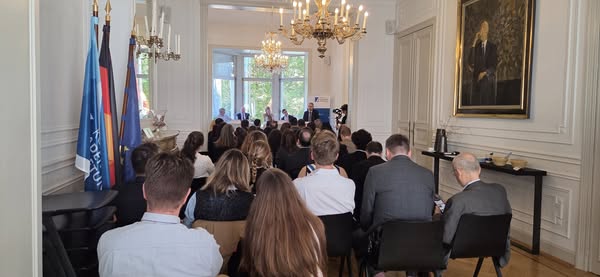
Brussels, 15 May 2025: In the framework of the #IGNITA initiative, the Kosovar Centre for Security Studies (KCSS), in cooperation with the Konrad-Adenauer-Stiftung (KAS) and Zasto Ne, and supported by Open Society Foundations – Western Balkans (OSF-WB), hosted a policy conference in Brussels to discuss ways to strengthen EU–Western Balkans cooperation in the digital and cybersecurity fields.
Held at the KAS European Office, the event gathered representatives from the European Parliament, European Commission, European External Action Service (EEAS), and other actors in Brussels. The discussion focused on advancing a structured and gradual integration of the Western Balkans Six (WB6) into the EU’s cybersecurity architecture, with particular attention to the possibility of granting observer status to WB6 countries in the EU Agency for Cybersecurity (ENISA) and implementation of Digital Services Act in the region.
In his opening remarks, KCSS Executive Director Mentor Vrajolli underlined the opportunity presented by the ongoing revision of the EU Cybersecurity Act. “Observer status in ENISA, tied to clear technical and political benchmarks, would create a framework for sustained cooperation,” he stated:
“Our work at KCSS is grounded in the belief that advancing the integration of the Western Balkans into the EU’s digital and cybersecurity structures is not only feasible, but urgent. Over the past months, as part of our advocacy work, we organized last year roundtables in Tirana and Berlin, bringing together experts, policymakers, institutional partners, and representatives of the WB6 countries. In both cases, the message was clear: bringing the Western Balkans closer to the EU in cybersecurity is a no-brainer. Everyone agreed—it’s logical, and necessary, for both sides, EU and WB6. Today, we are here to reaffirm that message—at a moment of strategic opportunity. The EU Cybersecurity Act is currently under revision, and this provides a concrete window to make one essential change: enable observer status in ENISA for candidate and potential candidate countries, provided they meet necessary conditions.”
Panelists echoed the importance of regional cooperation and regulatory alignment. Maida Ćulahović from the Bosnia and Herzegovina-based organization Zašto ne emphasized the need for a coordinated approach to implementing the Digital Services Act (DSA) across the region, noting that divergent national strategies could lead to regulatory fragmentation. She stated that:
“As an organization whose core mission is to promote accountability and combat disinformation—including by running two fact-checking platforms—we have come to a clear realization: without legally enforceable responsibilities for online platforms, our efforts often feel like putting out fires. Voluntary compliance by private, for-profit tech companies is not something we cannot rely on, as we have witnessed time and time again.What we are suggesting is for Digital Policy to be positioned at the heart of the EU enlargement, treating digital platforms governance not as a secondary concern but as a central pillar of the enlargement process. Why is this crucial? Digital policy today intersects with every major strategic priority: democratic resilience, economic integration, human rights protection, and geopolitical stability. ”
MEP Davor Ivo Stier framed the issue within the broader context of enlargement, while Michael Docherty from the European Commission’s DG ENER highlighted the strategic role of digital investment under the EU’s Growth Plan for the Western Balkans. Haris Avdić Pejičić of the EEAS spoke on addressing hybrid threats through closer policy and institutional cooperation.
KCSS and Zasto Ne presented a set of policy recommendations developed under the IGNITA initiative, including a roadmap for phased observer membership in ENISA, support for harmonized DSA alignment across WB6, and further investment in institutional capacity. The recommendations reflect ongoing efforts to move beyond project-based collaboration and towards long-term policy integration.
The roundtable concluded with remarks from OSF-WB Deputy Director Miodrag Milosavljević, who noted that while the Western Balkans are already digitally connected to the EU, institutional frameworks remain misaligned. “The question is not whether we are linked, but whether we are prepared to manage those connections securely,” he said.
The event builds on previous regional consultations in Tirana and Berlin and is part of KCSS’s wider advocacy to promote regional security cooperation and support the WB6’s gradual integration into EU structures.