25/06/2026
Kosovar Centre for Security Studies (KCSS)
Kosovar Centre for Security Studies (KCSS)
Danilo Kalezic
Since restoring independence in 2006, the country has pursued a strategic orientation toward Euro- Atlantic integration, culminating in NATO membership in 2017 and advanced accession negotiations with the European Union. At the same time, Montenegro has remained exposed to a range of external actors seeking to shape its domestic political development. While existing literature has predominantly focused on Russian influence in the region, recent developments suggest that external interference in Montenegro can no longer be understood through a singleactor framework. Instead, multiple authoritarian and semi-authoritarian actors pursue distinct strategies aimed at influencing the country's democratic development, foreign policy orientation, and institutional evolution.
Previous research demonstrated that Russia functions as a classic "Black Knight" actor by utilizing mechanisms of subversion, bolstering, coordination, and ideological dissemination to undermine democratization and constrain Euro-Atlantic integration. Russian influence has been particularly visible through support for anti-Western political actors, disinformation campaigns, identity-based mobilization, and efforts to weaken institutional trust. However, Russia is not the only external actor operating within Montenegro's political environment. Serbia and China have emerged as increasingly important sources of influence, although their objectives and methods differ significantly from those employed by Moscow.
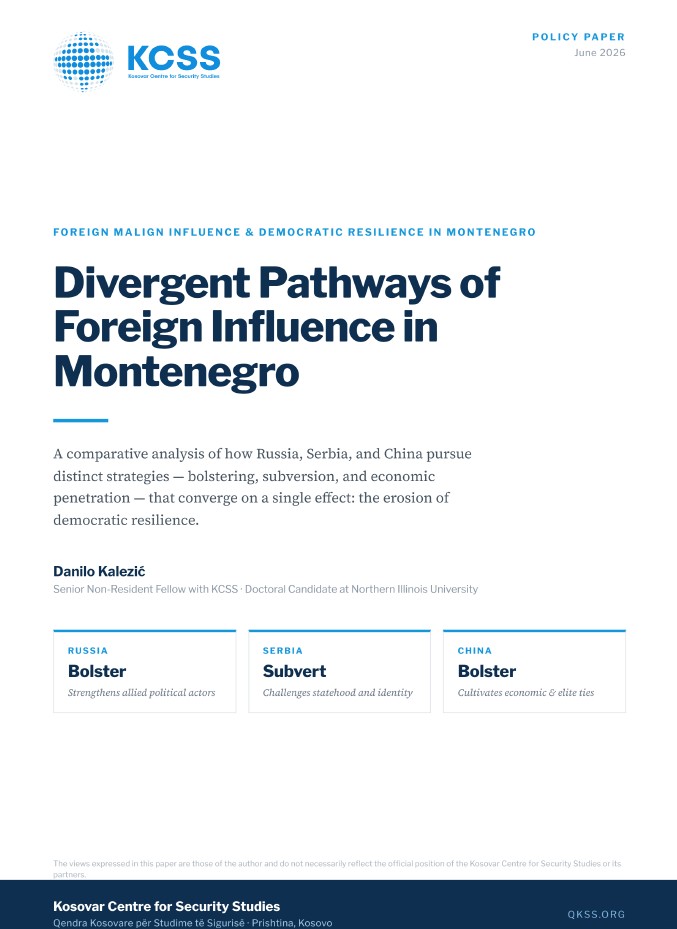
This article advances the argument that foreign malign influence in Montenegro is marked less by strategic convergence than by strategic differentiation. Russia, Serbia, and China each challenge democratic resilience and institutional autonomy, yet they do so through distinct mechanisms and with different strategic horizons. Russia relies primarily on bolstering sympathetic political, religious, and social actors in order to position Montenegro as a geopolitical Trojan Horse capable of advancing Russian interests within Euro-Atlantic institutions. Serbia, by contrast, relies predominantly on subversive strategies designed to weaken the legitimacy of Montenegrin statehood, obstruct the consolidation of a distinct political identity, and complicate European
integration. China pursues a more gradual strategy centered on economic penetration, elite cultivation, and institutional coordination, with the objective of establishing Montenegro as a regional platform for expanding Chinese influence across the Western Balkans and, eventually, toward the European market.
Although these strategies differ in form and intention, their cumulative effect is strikingly similar. By targeting institutions, legitimacy, and governance respectively, these actors deepen democratic vulnerability, weaken accountability mechanisms, and complicate Montenegro's Euro-Atlantic trajectory. Recognizing this strategic differentiation is therefore essential both for explaining contemporary democratic challenges in Montenegro and for developing a broader analytical framework for the study of authoritarian influence in small, geopolitically exposed democracies (Ambrosio, 2009; Tolstrup, 2015; Levitsky & Way, 2010).
The views and opinions expressed in this paper are solely those of the author and do not necessarily represent the official position of the Kosovar Centre for Security Studies (KCSS).