18/09/2025
Prishtina, September 18, 2025: Where will Kosovo stand in 2030? Will it be on the path to EU and NATO membership and regional cooperation, stuck in a cycle of stagnation, or facing instability and isolation.
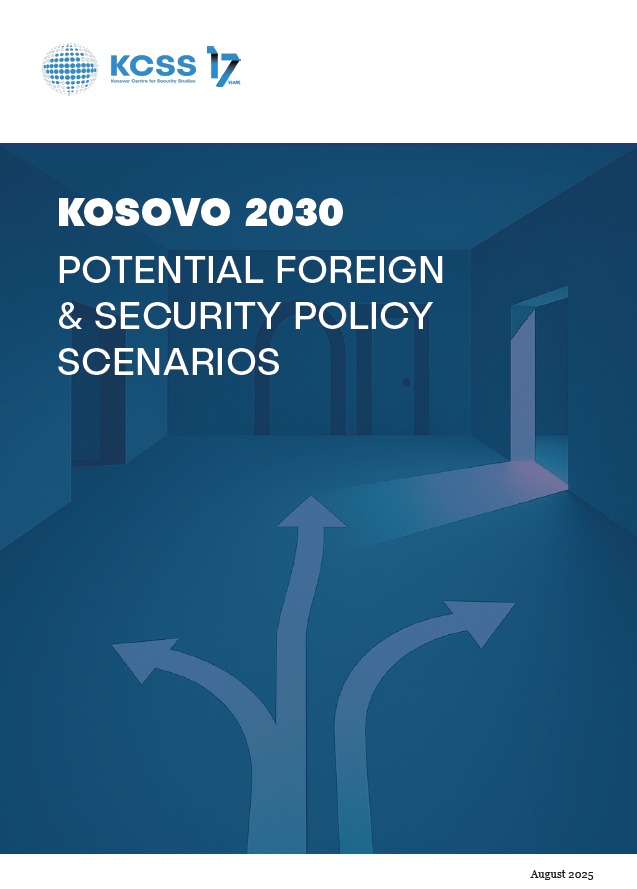
A new report by the Kosovar Centre for Security Studies (KCSS) titled “Kosovo 2030: Potential Foreign & Security Policy Scenarios” discusses three different potential outcomes or futures for the country’s foreign and security policy, which are shaped by internal decision, reforms, the normalization dialogue with Serbia, and Kosovo’s commitment and alignment with the Euro-Atlantic community.
The report sets out an optimistic scenario, where Kosovo consolidates its statehood, secures EU candidate status, membership in Council of Europe (CoE), advances relations with NATO such as becoming part of the Partnership for Peace, and integrates Serbs in the north through functioning institutions. A status-quo scenario discusses stagnation, where political crises and polarization, reforms half-done, and slow or stalled Euro-Atlantic integration. The pessimistic scenario warns of growing isolation and instability if Kosovo fails to manage internal divisions and external pressures.
A “wild card” section also explores how verdicts from the Kosovo Specialist Chambers could affect devlopments and Kosovo’s trajectory, either triggering instability or inspiring affirmative transformation in Kosovo’s relations with the Euro-Atlantic community.
“This report is a tool for policymakers and not a prediction,” said Mentor Vrajolli, Executive Director of KCSS. “Kosovo has choices to make. The next years can either strengthen our democratic and security credentials, or deepen polarization and uncertainty. Our aim is to provide policymakers and citizens with a map of the risks and opportunities ahead.”
The scenarios highlight two major drivers for Kosovo towards 2030. First is the EU-facilitated dialogue for normalization of relations with Serbia, and Kosovo’s progress in EU and NATO integration. Both are intertwined, and the success in one can unlock progress in the other.
Ramadan Ilazi, Head of Research at KCSS and author of the report, said that “The next five years will be decisive. Sequencing is critical, and making tough decisions at home, how we continue to approach the situation in the north of Kosovo, coupled with constructive engagement in the dialogue with Serbia, can open the door to Euro-Atlantic integration. But uncoordinated actions, backsliding in democratic performance risk pushing Kosovo into stagnation, or worse, instability and growing isolation.”
The report also underlines the importance of domestic political cohesion. Political polarization, institutional fragmentation, and weak inter-political party cooperation are described as factors that could undermine Kosovo’s credibility with international partners, even if external conditions remain favorable.
At the same time, it stresses that Kosovo is not without agency. Building credibility through reforms, deepening partnerships with NATO members, and engaging constructively in regional cooperation are all seen as ways to tilt the balance toward the positive scenario.
Ramadan Ilazi, also warned that “The verdicts of the Specialist Chambers in 2026 will be a turning point. If former KLA leaders are convicted, it risks fueling polarization and unrest. But if they are acquitted or released, it could mark a shift, a moment for Kosovo to turn the page, realign more firmly with the West, and rebuild trust in the Euro-Atlantic path. Either way, the impact will be decisive.”
KCSS hopes the report will serve as a reference point in the ongoing debate about Kosovo’s future, not only among policymakers but also within civil society, the media, and the wider public.
The full report, in the KCSS website.