23/07/2025
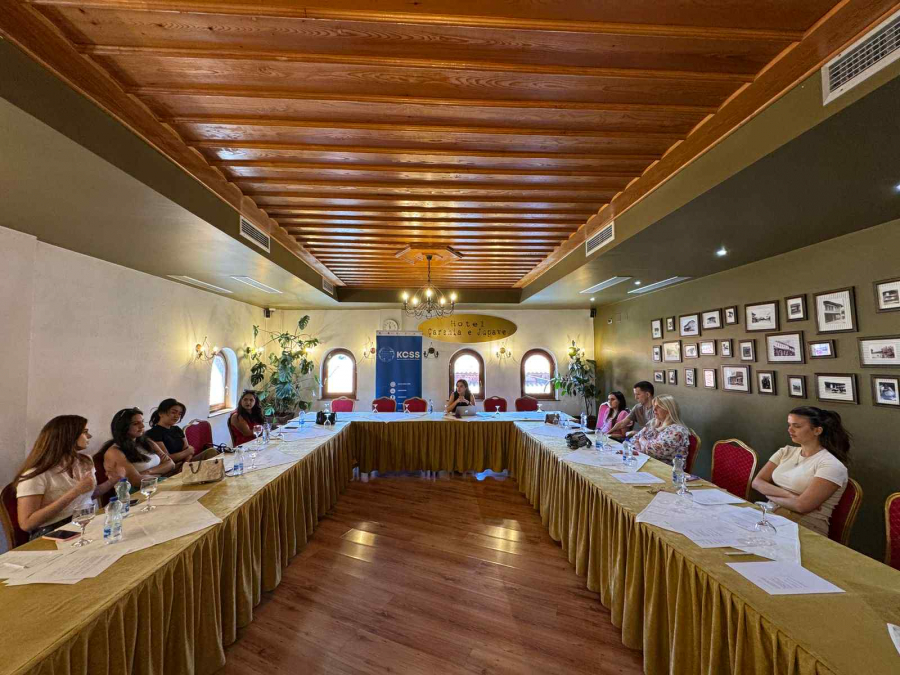
On July 22nd, 2025, the Kosovar Centre for Security Studies (KCSS) organized a local focus group in the city of Gjakova, hosted at Hotel Çarshia e Jupave, as part of the international research project OppAttune, Countering Oppositional Political Extremism Through Attuned Dialogue: Track, Attune, Limit, funded by Horizon Europe.
This activity was part of a broader regional effort to better understand how citizens across Kosovo perceive political extremism, experience manipulation and hate speech, and engage in public discourse in a context that is often deeply polarized. The event in Gjakova brought together participants from diverse backgrounds, including youth activists, civil society representatives, community volunteers, and local residents actively involved in civic life.
Participants reflected on how political extremism manifests at the local level, not just through ideology, but also through aggressive communication styles, public shaming, and a refusal to tolerate differing viewpoints. Many pointed to frustration with political stagnation and poor governance as underlying factors that contribute to radical political expressions.
The group discussed how manipulation has become a normalized tool in political competition, especially during election cycles. Several participants shared examples of misleading media narratives, polarizing rhetoric, and the instrumentalization of social media to spread one-sided political messages. There was a shared concern that citizens, especially young people, lack critical media literacy and are vulnerable to misinformation.
Social platforms were identified as double-edged tools: while they enable political participation, they also amplify hate speech, discrimination, and verbal attacks. Participants noted that offensive or divisive content often spreads faster than facts, contributing to a toxic online atmosphere and discouraging constructive dialogue.
A particularly sensitive part of the discussion centered on the experiences of women in public life. Participants highlighted the disproportionate targeting of women politicians and activists, who often face sexist commentary, body-shaming, and attacks unrelated to their professional performance. These patterns, according to attendees, contribute to a culture that discourages women's full political participation and reinforces harmful gender norms.
Despite differences in political ideology, participants expressed cautious optimism that cooperation is possible, particularly when it comes to shared community needs, such as security, youth engagement, or regional development. Some noted that disasters or national tragedies, like the 2019 earthquake in Albania, have historically united people across divides, suggesting that common ground can be found when mutual interest outweighs partisanship.
Participants spoke openly and critically, not only about political institutions but also about societal behavior. Several shared that they themselves had been exposed to or participated in polarizing rhetoric in the past but were now more aware of its consequences. The focus group created space for self-reflection, learning, and empathy, allowing participants to explore the psychological and emotional dimensions of radical discourse.
One participant emphasized, “We’re used to seeing hate and manipulation every day. It’s so normal now that we don’t even question it anymore. That’s why spaces like this matter, because they help us pause and think about what kind of society we really want to build.”
This focus group contributes to OppAttune’s broader objective of identifying how oppositional political extremism emerges and how democratic societies can respond through attuned dialogue. By engaging directly with communities, the project ensures that its findings and policy recommendations are grounded in real lived experiences, not just abstract theory.
The insights gathered in Gjakova will be integrated into the project’s comparative analysis and will inform upcoming publications, advocacy efforts, and tools for policymakers, educators, and civil society actors.
KCSS extends its sincere gratitude to all participants for their active engagement, openness, and honesty throughout the session. Their voices are essential to shaping policies and practices that foster inclusion, mutual respect, and democratic resilience in Kosovo.
OppAttune is a Horizon-Europe funded project involving 17 partners across Europe and beyond which aims to develop an innovative Attunement Model which will track, attune, and limit the spread of extreme political narratives. Co-Funded by the European Union with Grant Agreement No. 101095170.