18/11/2025
Prishtina, 18 November 2025
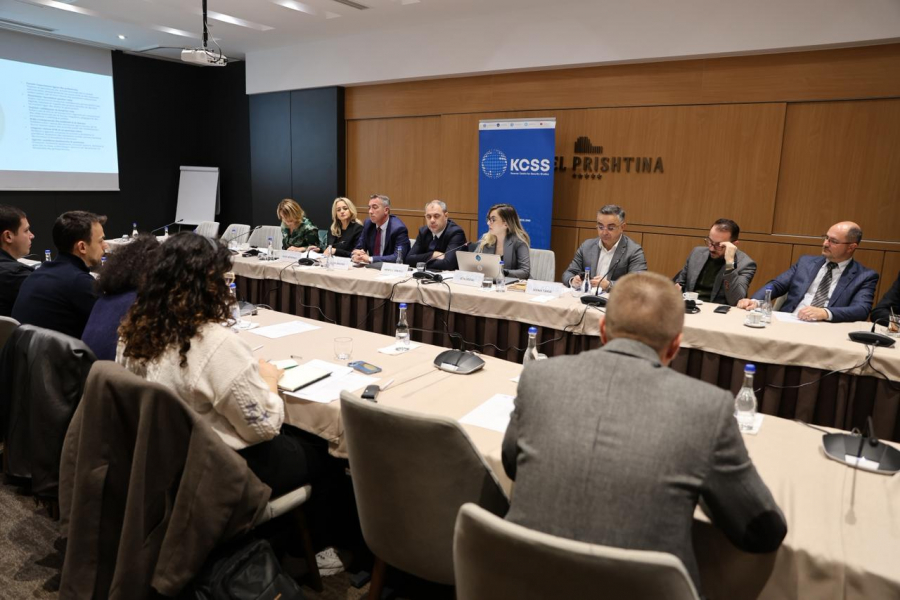
The Kosovar Centre for Security Studies (KCSS) today held the closing conference of its project “Strengthening the Role of Municipalities in Promoting EU Rule of Law Values in Kosovo”, supported by the Irish Department of Foreign Affairs. The event brought together representatives of municipalities, central institutions, civil society, and the Association of Kosovo Municipalities (AKM) to discuss progress and remaining challenges in aligning local governance with EU rule of law standards.
In his opening remarks, Mentor Vrajolli, Executive Director of KCSS, emphasized that municipalities remain the frontline institutions in delivering transparency, accountability, and legality—three pillars critical to Kosovo’s EU integration. He underscored the importance of strengthening capacities and cooperation across all levels of governance to sustain ongoing reforms.
The conference highlighted the important role of the Association of Kosovo Municipalities (AKM) in supporting the integration process. AKM’s Executive Director, Sazan Ibrahimi, noted that the organization works closely with all municipalities and coordinates two key professional bodies: the Collegium of EU Integration Officers and the Collegium of Legal Officers, both of which contribute to harmonizing municipal practices and increasing administrative preparedness. Importantly, Ibrahimi emphasized that Kosovo’s municipalities score highly on EU integration benchmarks, despite Kosovo not yet holding official candidate country status.
Ajshe Berveniku, Chair of the Collegium of EU Integration Officers from the Municipality of Prishtina, stressed the need for every municipality to have a designated EU integration officer. She noted that such positions are essential for effective monitoring, reporting, and internalizing EU principles within local policy processes. Berveniku also pointed to issues such as overlapping competencies in rural land management, the centralization of inspectorates, and the exclusion of municipalities from certain ministerial forums—all of which complicate the implementation of EU-related reforms at the local level.
Former First Deputy Prime Minister and National Coordinator for State Reforms, Besnik Tahiri, emphasized the necessity of stronger inter-institutional coordination. He discussed the need for more positive communication surrounding the multiethnic dimension of municipal governance.
Presenting the findings of the final KCSS report, researcher Jeta Loshaj highlighted notable improvements in legality checks, transparency practices, and compliance with EU-related obligations. However, there are still a few challenges identified. Municipalities continue to face persistent capacity gaps in legal offices, political interference, and weak coordination with central institutions, which undermine the consistent application of EU rule of law standards. Additionally, overlapping competencies, fragmented administrative instructions, and insufficient inclusion of women, youth, and minority communities pose further obstacles to effective implementation of EU-related reforms at the local level.
Participants also discussed the opportunities offered by the EU Growth Plan, including investments in drinking water access, railway revitalization, and other infrastructure priorities. The conference concluded with a call for continued cooperation between municipalities, central institutions, and international partners to further strengthen Kosovo’s alignment with EU rule of law standards.
Shqip