9/07/2025
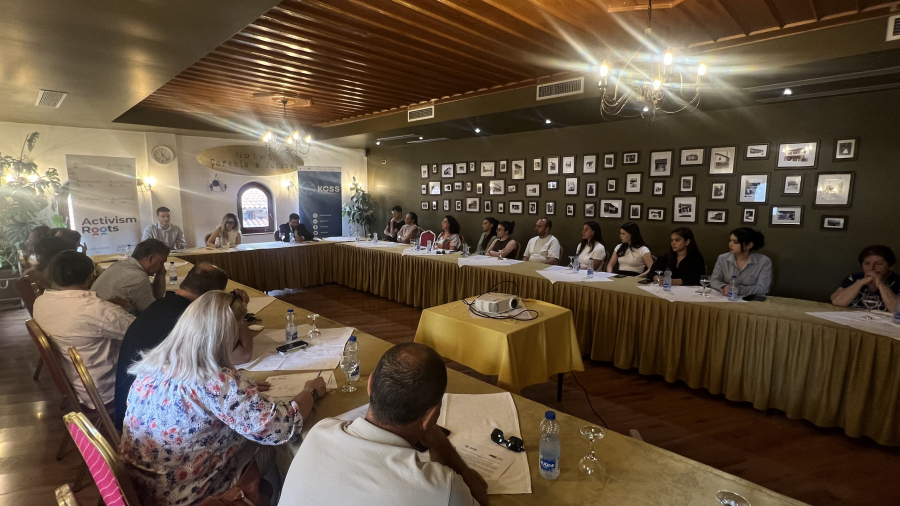
Gjakova, July 8, 2025
The Kosovar Centre for Security Studies (KCSS) concluded its series of community roundtables with a final discussion held in Gjakova, as part of the project “Promoting Government Transparency and Accountability in Interethnic Dialogue”, supported by the National Endowment for Democracy (NED).
The roundtable gathered participants from civil society organizations, local media, municipal officials, and community activists to explore the state of interethnic relations and social inclusion at the local level, with a particular focus on the Roma, Ashkali, and Egyptian (RAE) communities.
The discussion was moderated by Jeta Loshaj, researcher at KCSS, and included insights from Armend Behluli, Head of the Office for Communities and Returnees (OCR) in the Municipality of Gjakova, and Ideal Zhaveli, Director of Activism Roots.
Mr. Behluli highlighted the OCR’s ongoing efforts to provide equal access to municipal services and promote the integration of non-majority communities. He noted that approximately 8.4% of Gjakova’s population belongs to non-majority groups and that progress has been made since 2010, particularly in health, education, and employment. However, he acknowledged that challenges remain and emphasized that “cooperation should be the rule, not the exception.”
Mr. Zhaveli underlined the importance of bottom-up approaches in fostering interethnic understanding. He pointed to gradual improvements in the societal inclusion of RAE youth and noted that more than 100 businesses run by members of the RAE community are now operating in central Gjakova—a sign of progress and participation in public life.
Participants raised broader concerns related to global trends of discrimination, the impact of far-right narratives, and the persistence of early school dropout among marginalized groups. While scholarship opportunities exist, participants stressed the need for greater outreach and support.
Discussions also touched on Kosovo’s wider interethnic context, with some participants acknowledging the difficulty of cross-community dialogue—particularly between Albanians and Serbs—but agreeing that “some communication is better than none.”
Ms. Loshaj emphasized that interethnic cooperation is not only a constitutional obligation but a key step toward strengthening Kosovo’s statehood and EU integration path. She also highlighted the absence of a full transitional justice process and a shared societal narrative about the past as challenges to reconciliation.
In conclusion, while political narratives often portray interethnic tensions, participants agreed that citizens across communities largely face the same essential needs—access to quality education, employment, and healthcare. These shared challenges offer a foundation for future cooperation.
This event marked the final roundtable in the KCSS initiative, which has sought to highlight local voices and promote inclusive dialogue in municipalities across Kosovo.