16/09/2025
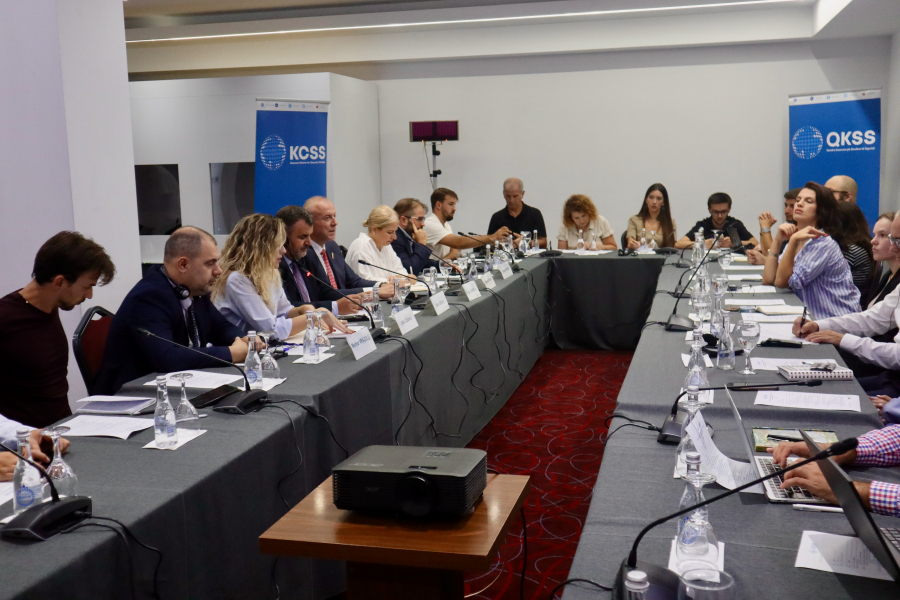
Prishtina, September 15, 2025 – The Kosovar Centre for Security Studies (KCSS) supported by National Endowment for Democracy (NED) convened a roundtable discussion on the subject “How can we increase interethnic cooperation and understanding in Kosovo?” gathering key voices from institutions, government, academia, and civil society to discuss the challenges, commitments, and pathways for building a more inclusive and cohesive society. Moderated by Ms. Jeta Loshaj, researcher and project associate at KCSS, the panel included distinguished speakers, Mr. Mentor Vrajolli, Executive Director at KCSS, Mr. Naim Qelaj, Kosovo Ombudsperson, Mr. Vigan Qorrolli, Deputy Minister of Justice, Ms. Aferdita Sylaj, Executive Director at Community Building Mitrovica, and Mr. Ognjen Gogic, Political Analyst. The discussion revolved around the key issues such as protecting rights and addressing community concerns, the Government’s approach to interethnic cooperation, and the role of civil society as a bridgebuilder.
Kosovo Ombudsperson Mr. Naim Qelaj reaffirmed his commitment to the protection of minority rights and emphasised the Ombudsperson’s cooperation with civil society in ensuring that all citizens of Kosovo receive equal treatment and access to services.
Highlighting ongoing challenges such as the abandonment of institutions, persistent language barriers, and issues of institutional independence, Mr. Qelaj noted that interethnic communication at the national level could be significantly improved. He revealed that the number of complaints submitted to the Ombudsperson’s Office this year has tripled compared to last year. He believes that unresolved political questions in the north are affecting the daily lives of marginalised and minority groups, and that, apart from common challenges, there are also specific disputes. For instance, the struggle for the Serbian community to obtain personal documents and access to social services. In addition, he underlined the seriousness of the Assembly’s lack of monitoring mechanisms and acceptance of the Ombudsperson recommendations.
Mr. Vigan Qorrolli, the Deputy Minister of Justice, stressed that transitional justice must not be seen as merely a policy, but as a cornerstone of democracy. He outlined the moral obligation of younger generations not to forget the injustices of the past, while pointing to Serbia’s continued concealment of evidence related to missing persons as a fundamental barrier to reconciliation.
He noted that war crimes and outstanding responsibilities remain an open wound, adding, “there should not be divisions, there should be hope.” According to Mr. Qorrolli, the path to reconciliation in Kosovo must walk hand in hand with the truth. Moreover, he mentioned some achievements of the current government, such as the creation of the Institute for the Documentation of War Crimes and the ten-year strategy for transitional justice (2024-2034). The plan aims to orient institutions towards the documentation of facts and the possibility of facing legal responsibilities, as well as the introduction of a more flexible penal code that enables the Office of Prosecution to investigate and prosecute in absentia.
Ms. Aferdita Sylaj, Executive Director of Community Building Mitrovica described civil society as a key peace-building actor. She highlighted the role of local NGOs in fostering communication across divided communities, building trust and confidence, and amplifying the voices of marginalised individuals, particularly through youth exchanges, multi-ethnic organisations, and dialogue platforms. “There is a need for initiatives to bring people together,” she claimed.
Among the achievements of the Community Building Mitrovica, she highlighted the creation of the School of Rock Music, helping to bridge the gap for young people through music. The initiative to reinforce women’s roles in their community, and the establishment of a Master's Program in Human Rights and Transitional Justice in the University of Prishtina, as well as the education of citizens on the consciousness of their power in improving inter-ethnic dialogue. As a final remark, she believes that an overall strategy for integrating the non-majority community is lacking and highlighted that it should be implemented at a political level, rather than through civil society organisations alone.
Representing the perspective of Kosovo’s Serbian community and civil society, Mr. Ognjen Gogic, who reflected on the stalemate in both Brussels and Prishtina-led dialogues, stated that “the conditions we work under are not meant for dialogue.” He further underlined that civil society cannot replace official representatives. Still, unfortunately, according to Gogic, they are compelled to do political work. He accentuated that the current vacuum of political representation for the Serbian community, alongside the domination of the Serbian List without viable alternatives, has further complicated interethnic cooperation in a wider scope.
Gogic further noted that civil society is often left to fill this void despite lacking access to documents, rights to propose amendments, or institutional support. He called for renewed political engagement to support civil society’s parallel efforts.
Conclusion
KCSS remains committed to promoting constructive dialogue, inclusivity, and evidence-based policies as vital tools for strengthening interethnic cooperation and understanding in Kosovo. While civil society plays a supportive role, it cannot replace the responsibility of government institutions. Likewise, Ombudsperson’s contributions are valuable, but its recommendations must be fully implemented. Achieving sustainable peace requires more than dialogue; it demands the meaningful engagement of multiple actors, be that central and local institutions, the civil society, and the citizens.
Shqip