25/09/2025
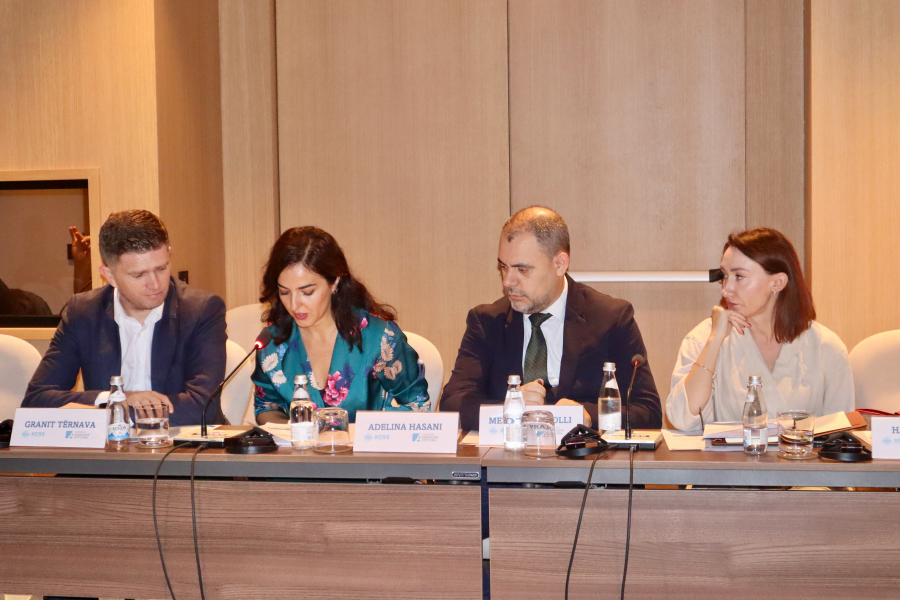
The Kosovar Centre for Security Studies (KCSS), in cooperation with the Konrad-Adenauer-Stiftung (KAS) Kosovo, hosted a conference to present the report “China’s Silent Footprint: Mapping Chinese Influence on Local Politics and the Economic Landscape in Kosovo” authored by Adelina Hasani, senior researcher at KCSS.
Opening remarks were delivered by Mentor Vrajolli, Executive Director of KCSS, and Granit Ternava, Program Manager at KAS, who both highlighted the importance of addressing China’s growing influence in Kosovo within the broader geopolitical context.
Presenting her research, Ms. Hasani underlined China’s strategy of quietly expanding its presence in Kosovo and the Western Balkans through economic channels, avoiding overt political interference while promoting narratives of sovereignty. She explained that China’s activities, aligned with its broader foreign policy and the Tao Guang Yang Hui principle, aim to undermine Kosovo’s international standing while deepening economic ties in the region, mainly through Serbia.
Hasani stressed key findings:
Economic influence – While China has no direct large-scale investments in Kosovo, it operates through Chinese-owned companies registered in Europe, making its footprint harder to monitor.
Security concerns – Chinese surveillance equipment purchased by institutions in Kosovo posed potential security risks, as they were later found to be on U.S. blacklists.
FDI differences – Unlike EU grants and investments, Chinese engagement is often loan-based, raising concerns of debt dependency, as seen in Montenegro.
Local engagement – The Chinese liaison office in Prishtina has been proactive in establishing contacts with local leaders, signaling a long-term strategic approach.
Hasani emphasized the urgent need for a national database to track foreign investments and partnerships in Kosovo and closer cooperation with European partners more experienced in countering such challenges.
Panelist Prof. Hajdi Xhixha, Dean of Political Science and Security Studies at UBT College, compared Chinese and Russian approaches in the Western Balkans. She noted that while Russia employs overt hybrid warfare tactics and disinformation, China’s influence remains primarily economic and soft power–driven, meaning the two powers pursue different, but potentially complementary, objectives in the region.
In the open discussion, participants recognized the report as an important foundation for future research and highlighted the need for Kosovo to strengthen dialogue with allies. Several noted that Europe has been slow in responding to Chinese influence, while U.S. soft power tools—such as USAID support for democracy and civil society—have diminished, leaving gaps that China could quietly exploit.
Report is available here: China’s quiet Footprint: Mapping Chinese Influence on Local Politics and the Economic Landscape in Kosovo