3/12/2025
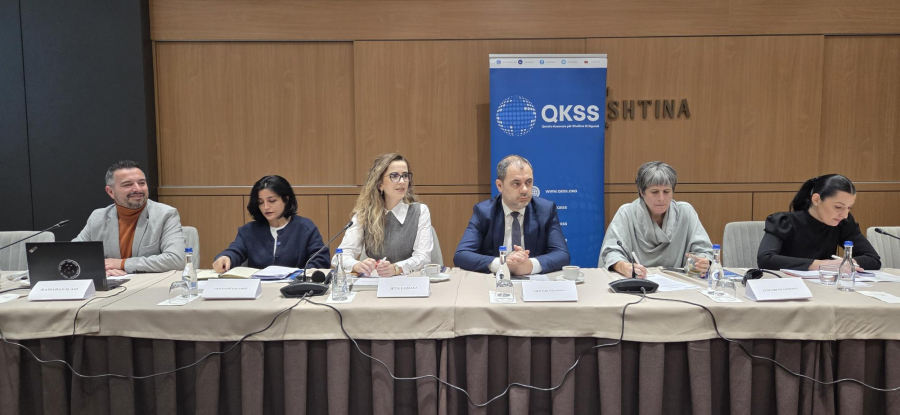
Prishtina, December 3, 2025 — The Kosovar Centre for Security Studies (KCSS) marked the conclusion of the DISRUPT project with a roundtable event that brought together experts, civil society representatives, media professionals, and government officials, to examine the challenges posed by disinformation and its impact on interethnic relations in Kosovo.
The roundtable featured presentations and remarks from Mentor Vrajolli, Executive Director of KCSS; Dr. Ramadan Ilazi, Head of Research at KCSS; Elizabeth Gowing, Adjunct Faculty at RIT Kosovo; Adea Beqaj, Media and Communication Researcher; and Gentiana Paçarizi, Managing Editor at Kosovo 2.0. Participants engaged in a discussion on the findings of the DISRUPT project’s final report, “How Disinformation Fuels Ethno-Political Radicalization in Kosovo.”
Dr. Ilazi’s presentation highlighted how disinformation, intentionally spread false information, has become a powerful tool for deepening ethnic divides and undermining reconciliation efforts in Kosovo. The research shows that both foreign and domestic actors play a role in spreading divisive narratives. External influences, particularly from Russia and Serbia, use media and digital platforms to fuel polarization, while local political elites also exploit disinformation for political gain. The report reveals that narratives are carefully tailored to each community: Kosovo Serbs are often portrayed as victims of persecution, while Kosovo Albanians are exposed to stories of external aggression. Social media platforms such as Telegram, Facebook, and TikTok have emerged as key channels for the rapid spread of hate speech, conspiracy theories, and emotionally charged content. These dynamics and disinformation campaigns have made efforts at normalization of relations between Kosovo and Serbia and overall societal reconciliation more difficult, as disinformation sabotages dialogue and erodes trust in the process and institutions.
The roundtable also reflected on the local consultations held in Mitrovica, Viti, and Shtërpcë, in the framework of the DISRUPT project where municipal officials, civil society, educators, youth, and security actors discussed the effects of disinformation at the community level. These consultations revealed significant gaps in media accountability, especially among online outlets, and identified both youth and the elderly as particularly vulnerable to manipulative content. Participants noted that local actors are willing to engage in countering disinformation but often lack the necessary resources and structural support. There was a strong call for more active government involvement in fact-checking and strategic communication.
As the event concluded, participants emphasized the need for government support for independent fact-checking organizations and the creation of dedicated units to monitor and debunk disinformation. Civil society and media initiatives should be multiethnic and bilingual to ensure accessibility and trust across communities. The appointment of Serbian-speaking spokespersons in government ministries was recommended to improve communication and representation. Media organizations were encouraged to enforce editorial standards that include diverse sources and invest in fact-checking capacities. The establishment of community-based workshops and municipal crisis communication teams was also highlighted as a priority for responding quickly and accurately during interethnic incidents.
Looking ahead, KCSS will develop a comprehensive policy memo based on the roundtable’s findings and recommendations. This memo will be shared with government institutions to inform future strategies for countering disinformation and strengthening social cohesion in Kosovo.
For more information and access to the full report, visit How Disinformation Fuels Ethno-Political Radicalization in Kosovo