28/10/2025
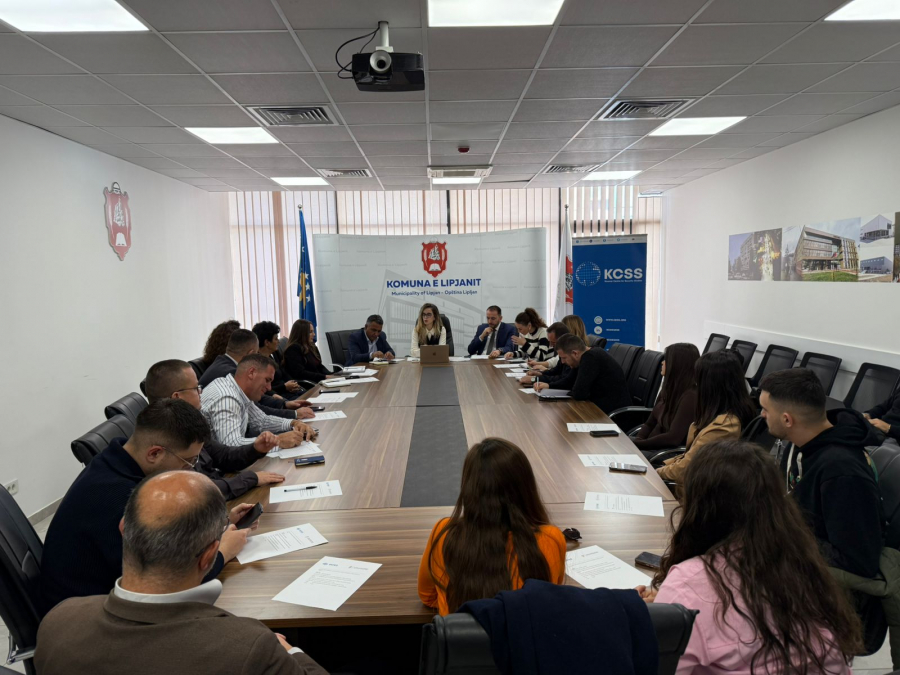
On October 28, the Kosovar Centre for Security Studies (KCSS) organized a roundtable in the Municipality of Lipjan on “The Role of Municipalities in Promoting Rule of Law and EU Values in Kosovo”. The discussion gathered senior municipal representatives, including the Chief of Cabinet of the Municipality of Lipjan, Mr. Avni Jashari, the former Deputy Mayor, Mr. Lulzim Qerimi, and officials from various municipal departments, to discuss the role of local institutions in advancing European values and principles of good governance. The discussion was moderated by Jeta Loshaj, researcher at KCSS.
This activity forms part of the KCSS project “Strengthening the Role of Municipalities in Promoting EU Rule of Law Values in Kosovo,” supported by the Irish Department of Foreign Affairs. The project aims to deepen the understanding of how municipalities contribute to the consolidation of democratic governance, enhance the rule of law, and advance Kosovo’s European integration process.
The meeting served as a platform to present the preliminary findings of the forthcoming report authored by Rozafa Ukimeraj, titled “Strengthening the Role of Municipalities in the Promotion of EU Rule of Law Values in Kosovo.” The study highlights the increasing contribution of local governments to Kosovo’s European integration process, focusing on legality, transparency, accountability, and inclusivity. The report will be officially launched at a final conference later this month.
Lipjan as a Model Municipality for Transparency and Rule of Law
Participants noted that Lipjan stands out among Kosovo’s municipalities for its strong performance in transparency, accountability, and bilingual administration. The municipality’s progress was illustrated through several examples, including the establishment of a digital property management system supported by USAID—the only such initiative in Kosovo—enhancing transparency and efficiency in local land administration. Lipjan also maintains active village youth councils, ensuring grassroots participation in local decision-making. In 2023, the municipality was awarded by the Council of Europe for good governance practices.
Challenges in Central–Local Coordination
Despite progress, officials discussed ongoing challenges in communication and coordination between central and local levels. Participants noted that while municipalities strive to meet EU-related benchmarks, delays and limited responsiveness from central institutions often hinder implementation. For instance, Lipjan’s municipal development plan, finalized in 2023, remains pending approval from the ministry, resulting in lower performance scores in national assessments.
The discussion also underscored limitations in staff capacity, particularly in legal offices and international project management units. Lipjan has five legal officers, yet smaller municipalities often rely on a single official. Moreover, while municipalities are eager to engage in EU-funded programs, they face restricted access to IPA funds, as applications typically must go through central ministries.
Commitment to Inclusivity and Community Engagement
Participants emphasized Lipjan’s commitment to inclusivity, noting efforts to support minority communities, reintegration of returnees, and assistance to vulnerable families. The municipality also collaborates with civil society and international partners to promote cultural heritage protection, gender equality, and youth empowerment.
Officials highlighted that the values of the European Union—legality, respect, inclusiveness, and accountability—should be reflected in everyday governance behavior, from citizen service to community relations.