20/10/2025
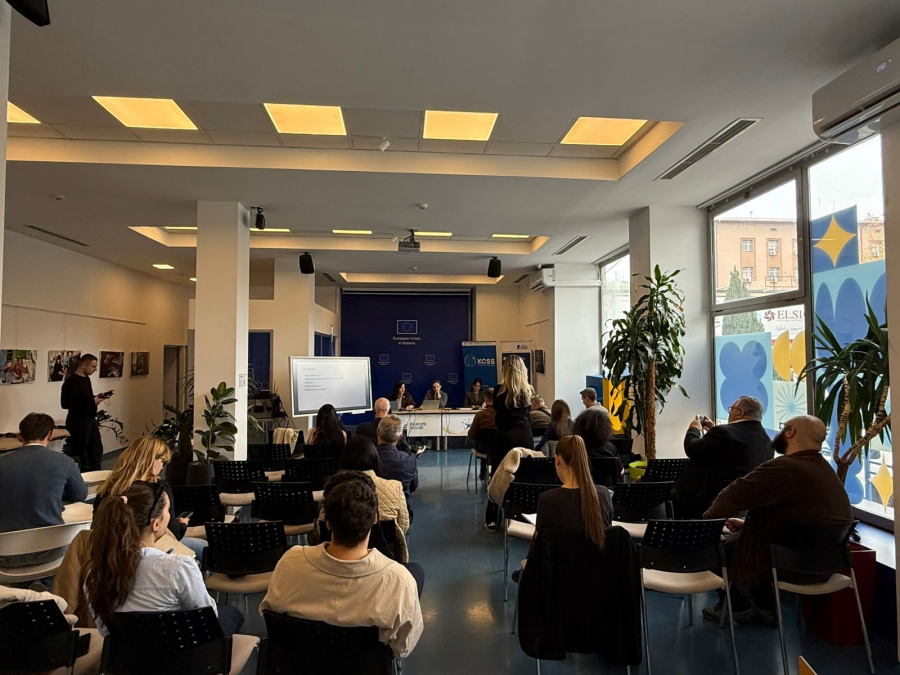
On Friday, October 17th, the Kosovar Centre for Security Studies (KCSS), in partnership with the Center for Security Studies (CENSS) Ukraine, the Konrad Adenauer Foundation, and the Open Society Foundation, hosted a high-level public discussion at Europe House, Prishtina, titled “Information Warfare and the Battle for Narratives.”
The event brought together policymakers, researchers, journalists, and representatives from civil society to explore one of the most pressing security challenges of our time — the use of information, disinformation, and hybrid tactics as strategic tools of influence and destabilization.
Discussions focused on how the Russian Federation employs a broad arsenal of military and non-military means to achieve geopolitical objectives. These range from propaganda, disinformation campaigns, and cultural diplomacy to the instrumentalization of religion and the use of paramilitary proxies. Participants emphasized the concept of “plausible deniability”, a tactic that allows states to deny involvement while covertly influencing internal divisions within target societies.
A central part of the event featured presentations by Adelina Hasani, Senior Researcher at KCSS, and Viktoriia Voronina, Executive Director of CENSS. They presented preliminary findings of their research on Russian hybrid threats and attacks in the Western Balkans, with a particular focus on Kosovo and the similarities it shares with Ukraine. Their comparative analysis provided valuable insights into the evolving nature of hybrid threats across different geopolitical contexts.
Speakers examined how Russian narratives exploit economic, cultural, and political vulnerabilities, undermine trust in institutions such as NATO and KFOR, and promote the notion of “failed states” to justify external intervention. The role of the Russian Orthodox Church was also discussed, highlighting its dual function as a soft-power instrument and, in some cases, a facilitator of intelligence activities abroad.
The discussion also covered the broader dynamics of Serbia-Russia cooperation in the fields of intelligence, propaganda, and paramilitary coordination, a relationship with significant implications for stability in the Western Balkans.
The event concluded with a call for stronger regional cooperation, more effective strategic communication, and greater civic awareness as essential tools to counter foreign malign influence. Participants underscored the need to build societal resilience, improve media literacy, and support independent journalism to reduce the impact of disinformation campaigns.
This event is part of KCSS’s ongoing commitment to inform, educate, and engage stakeholders on emerging security challenges and to foster a coordinated response to hybrid threats targeting Kosovo and the broader Western Balkans.